GreenSquareAccord has spent recent years closing offices and facilities (including the much hyped offsite housing manufacturer LoCaL Homes), restructuring services, making posts redundant and repeatedly telling residents that difficult financial decisions must be made. Residents are expected to accept rising costs, increasing service charges, reduced local access and continued pressure on frontline services. Against that background, it is entirely reasonable to ask what has happened to a project developed inside GreenSquareAccord that is now being marketed commercially by another organisation.
The Trials of Mrs Tranter was created and piloted within GreenSquareAccord as an immersive staff-training exercise based on customer complaints and service failures. Participants were asked to examine evidence packs, correspondence, call logs and recreated system records in order to understand how poor communication and fragmented services affect residents. GreenSquareAccord promoted the project as its own innovation, entered it for awards in its own name and rolled it out across the organisation.
The evidence now available suggests this was not simply a private idea belonging to one executive. The work involved recreated call logs, system screenshots, correspondence and other documents designed to resemble a genuine complaint case. GreenSquareAccord staff time, systems, experience and organisational resources therefore appear to have been central to the project’s development.
Steve Hayes, GreenSquareAccord’s former Director of Corporate Affairs and Communications, claimed the project was his, an idea ‘that came to him in the shower’, and is publicly described as its creator. His position at GreenSquareAccord was subsequently made redundant. He has since joined Creative Bridge as Associate Executive Director of Market Development and Partnerships, and Creative Bridge is now actively promoting and selling Mrs Tranter to other housing providers and public-sector organisations through a dedicated website and its wider marketing channels.
Creative Bridge describes Mrs Tranter as “A Creative Bridge project”, while also acknowledging that it was developed and piloted in-house by GreenSquareAccord. That raises an obvious question. At what point did a GreenSquareAccord project become a Creative Bridge commercial product?
GreenSquareAccord is a not-for-profit housing provider. Its income comes largely from residents through rent, service charges, management charges and other payments connected to people’s homes. We are not claiming that every pound spent developing Mrs Tranter came directly from individual service-charge accounts. We are saying that residents funded the organisation, salaries, systems and infrastructure through which the project was created. Residents therefore have every right to ask who now owns it, who approved its commercial use and what return GreenSquareAccord receives.
Was the project sold, assigned or licensed to Creative Bridge? Was it independently valued? Does GreenSquareAccord receive an upfront payment, annual licence fee, royalty, revenue share or payment each time another landlord purchases it? Did the commercial opportunity form any part of Steve Hayes’s departure arrangements? Were potential conflicts of interest formally declared and managed, particularly given his existing relationship with Creative Bridge while still employed by GreenSquareAccord? These are not accusations. They are basic governance questions that should have straightforward answers.
Creative Bridge has no direct relationship with GreenSquareAccord residents. Residents do not appoint its directors, scrutinise its decisions or receive its accounts. Yet it is now commercialising a programme developed inside GreenSquareAccord and built around the experiences of housing residents. It is therefore entirely fair to ask where the money goes, who receives it and whether GreenSquareAccord residents obtain any benefit from the continued sale of the project.
The housing associations now adopting Mrs Tranter also have questions to answer. Magna Housing, Nottingham Community Housing Association, Karbon Homes, Watmos Community Homes, Greatwell Homes and Gentoo Group have all been publicly associated with the project, alongside GreenSquareAccord. Other organisations are reportedly joining what Steve Hayes described as the “Mrs Tranter movement”. Residents of those landlords are entitled to know how much is being paid, what procurement process was followed, what evidence supports the purchase and what measurable improvement has resulted.
There is a wider concern here about money moving around the housing sector. Residents are repeatedly told that providers face financial pressure, that services must be cut and that difficult choices have to be made. Yet the same organisations continue to spend money on consultants, training products, conferences and branded initiatives promoted by former executives and sector insiders. At what point does collaboration become little more than money circulating between housing associations, consultancy businesses and the same small network of senior figures?

The Tainting of Mrs Tranter
Who Owns It, Who Pays for It and Who Is Profiting?

The mysterious 43%
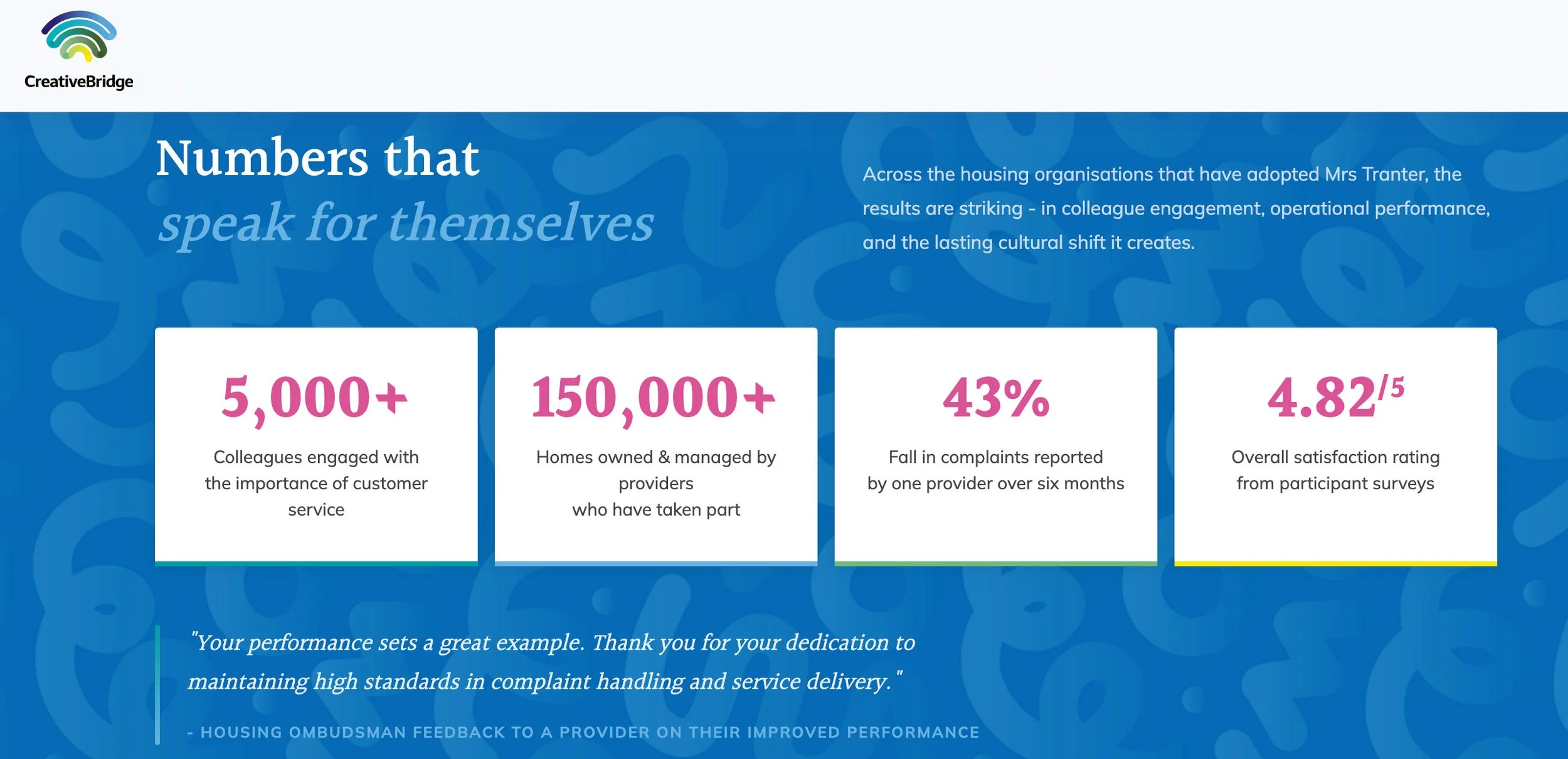
The commercial promotion of Mrs Tranter repeatedly relies on an eye-catching claim that complaints fell by 43% following its introduction. That figure appears in award material, professional portfolios and promotional descriptions, but no supporting data has been published. There is no stated baseline, comparison period, service area, definition of a complaint, raw complaint total, calculation method or independent verification. Nor is there any published analysis showing how Mrs Tranter was separated from other operational changes and credited with causing or contributing to the alleged reduction.
Forty-three per cent of what, compared with which period, across which services, and counted in what way? Does the figure refer to complaints received, complaints formally logged, complaint cases, individual complaint stages or something else entirely? Who calculated it, what other changes occurred during the same period and what evidence establishes any causal link between a staff-training exercise and the claimed reduction?
Surely any housing provider undertaking a proper procurement process would demand the evidence behind such extraordinary claims: if Mrs Tranter genuinely reduced complaints by 43%, why is the supporting data not publicly available, what due diligence did these landlords carry out, and what independent scrutiny satisfied them that they were buying a proven intervention rather than an impressive but unverified marketing claim?
Surely the Institute of Internal Communication, before awarding The Trials of Mrs Tranter four Gold Awards at the 2026 IoIC Awards, should have interrogated and benchmarked the claims being presented to it rather than accepting Creative Bridge’s material at face value. The 43% reduction in complaints is unsupported by any published baseline, methodology or source data, while the Housing Ombudsman quotation displayed alongside it does not mention Mrs Tranter, identify the provider, give a date or establish any connection between the programme and the alleged improvement. Yet these unverified claims appear to have been treated as evidence of impact and helped underpin an award-winning submission.
A fall in recorded complaints does not automatically mean services have improved. Complaint numbers can also fall when complaints are ignored, treated as service requests, rejected, left unregistered, closed prematurely or abandoned by residents who have lost confidence in the process. GreenSquareAccord has recently faced criticism over correspondence being ignored and complaints not being handled properly. Against that background, any claim of a dramatic reduction in complaints requires evidence, not applause.
Until GreenSquareAccord publishes the underlying figures and methodology, the 43% claim should be treated as an unverified marketing claim rather than an established fact. If Creative Bridge is using that figure to sell the product to other landlords, it should also explain what evidence it checked before relying on it in commercial promotion.
Residents have a right to know
GreenSquareAccord has closed offices, reduced posts and made staff redundant while continuing to tell residents that resources are limited. If an asset developed by its employees now has commercial value, the organisation should be able to show that it was properly protected, valued and used for the benefit of GreenSquareAccord.
If Creative Bridge has entered into a legitimate licence and GreenSquareAccord receives a fair return, then both organisations should say so. If the arrangement was approved by the Board, reviewed by legal advisers, assessed for conflicts and checked by auditors, there should be a clear governance trail. If the 43% claim is supported by reliable data, that evidence should be published.
None of this should be difficult where the arrangement is proper and the claims are sound.
We have written directly to GreenSquareAccord’s Chair, Chief Executive, finance and governance executives. The full Board and the Regulator of Social Housing have been copied into that correspondence. Housing Sector has separately approached Creative Bridge and Steve Hayes, giving them a full opportunity to explain the ownership, licensing, financial arrangements, conflicts of interest and evidential basis for the performance claims now being used to promote Mrs Tranter.
There may be a perfectly legitimate explanation. GreenSquareAccord may retain ownership, Creative Bridge may operate under a formal licence and residents may ultimately benefit from every sale. The 43% reduction may also be supported by robust internal data that has simply never been published.
Whilst GreenSquareAccord is already under regulatory scrutiny over its governance and its service failures, that continue to mount, residents and prospective customers should not be expected simply to accept its claims on trust. GreenSquareAccord has yet to publish evidence that Mrs Tranter produced the results now being used to market it, its services have plainly not been transformed by the exercise, and housing providers considering spending residents’ money on what is ultimately a training game should insist on independently verifiable outcomes before helping a former executive further commercialise the idea and build his sector profile around it.
But residents should not be expected to guess.
Where residents’ money, staff time, complaint experiences and organisational resources have contributed to something of commercial value, residents have a right to know who owns it, who pays for it and who profits from it.
That is not unreasonable. It is basic transparency, something that continues to be lacking from a sector that already boast about their transparency and openness.
Updates to follow.