
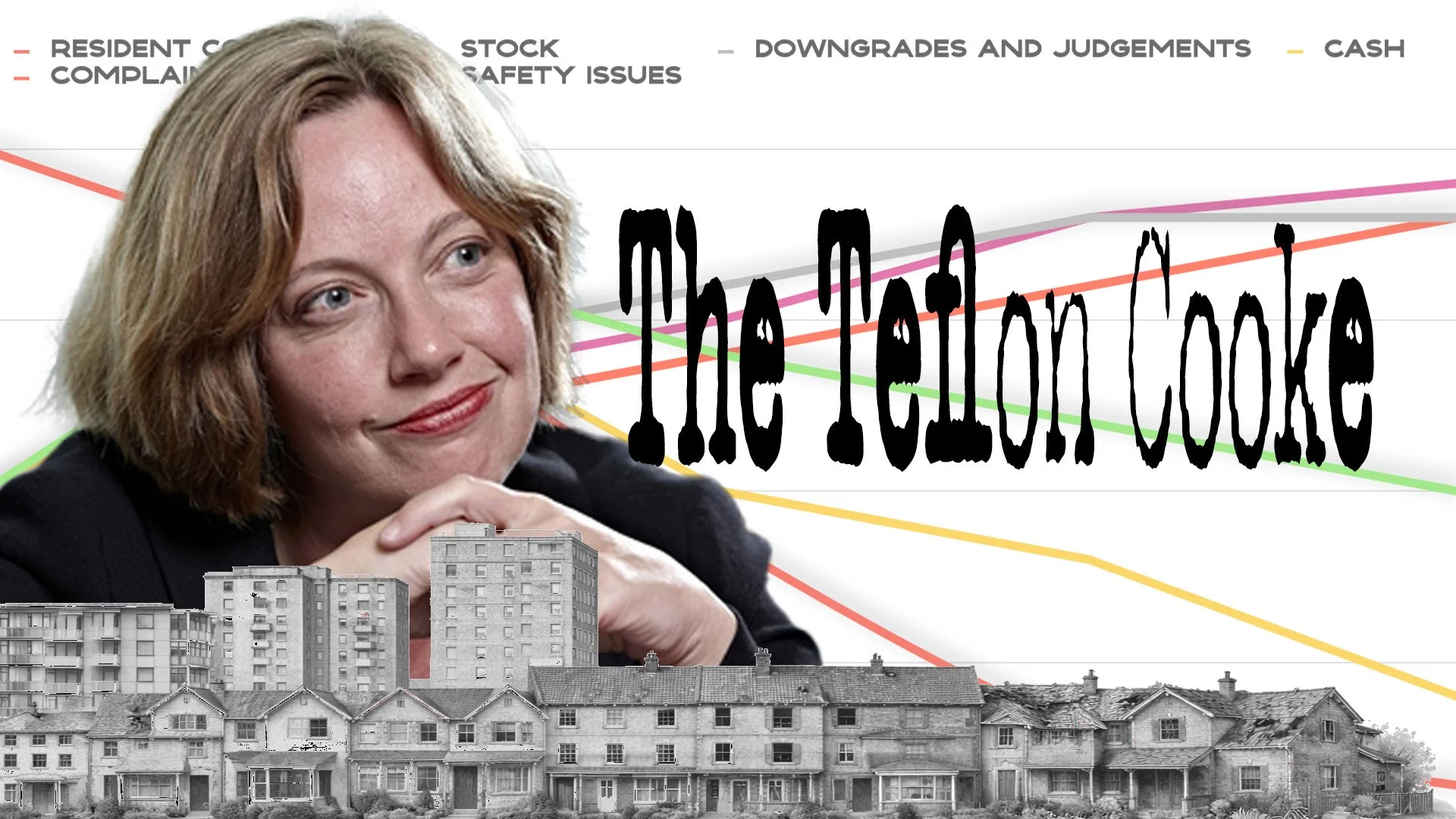
The Teflon Cooke
How Ruth Cooke survived a merger, multiple failures, and still stays at the top
This is not a personality attack. It is not gossip. And it is not speculation. It is a record.
A record of decisions, warnings, failures, investigations, and outcomes at GreenSquareAccord — all of them taking place under the leadership of Ruth Cooke.
Residents are often told to judge housing associations on evidence, not emotion. This article does exactly that.
Since April 2021, Ruth Cooke has been the chief executive of GreenSquareAccord. During that period, the organisation has faced repeated safety failures, regulatory intervention, severe maladministration findings, a ministerial rebuke, governance and credit downgrades, financial losses followed by recovery through sell-offs and closures, staff redundancies, the collapse of a flagship subsidiary, and ongoing restrictions on resident challenge.
Despite all of this, Ruth Cooke remains in post.
This raises a simple but unavoidable question: how does failure keep sliding off — and why does it never stick at the top?
Before the merger: warning signs already visible
Long before GreenSquareAccord existed, GreenSquare Group was already under regulatory scrutiny.
In March 2019, the Regulator of Social Housing issued a regulatory notice against GreenSquare Group for breaches of landlord health and safety duties. These included failures in fire safety management, overdue gas safety certificates, concerns about lift safety, and weaknesses in how fire risk actions were followed up.
The regulator treated these as serious, systemic failings. GreenSquare was required to commission a root-cause analysis examining governance, leadership, and organisational culture — not just operational processes.
This context matters. It undermines later attempts to suggest that post-merger problems were inherited solely from Accord stock. Significant compliance failures already existed on the GreenSquare side before any merger took place.
A leadership reset — without real consequence
Following the 2019 regulatory intervention, GreenSquare replaced its chief executive. Howard Toplis left and was replaced by Ruth Cooke.
This change was presented as a reset. A new leader. Lessons learned. A renewed focus on safety and landlord responsibility.
But the handling of that transition set an early precedent. Mr Toplis did not leave the sector under a cloud. In April 2020, Inside Housing reported that he had been appointed chief executive of Tai Calon Community Housing.
The regulatory breaches that occurred under his leadership did not prevent his reappointment elsewhere. They were contextualised, absorbed, and quietly moved past.
This pattern — failure without consequence — would later define GreenSquareAccord.
The merger: a “merger of equals” in name only
On 1 April 2021, GreenSquare Group merged with Accord Housing Group to form GreenSquareAccord.
Publicly, the deal was described as a merger of equals. In practice, leadership continuity flowed in one direction.
Accord’s long-standing chief executive, Dr Chris Handy, retired before the merger completed. Ruth Cooke became chief executive of the newly formed organisation.
There was no shared leadership, no co-chief executive period, and no external reset at the top. GreenSquare leadership moved forward intact, while Accord leadership stepped aside.
GreenSquareAccord launched as a 25,000-home landlord with a national footprint and ambitious promises about what scale would deliver.
Before residents were asked to accept the merger, they were given clear assurances.
In correspondence during the consultation process, Ruth Cooke acknowledged GreenSquare’s earlier regulatory failings and described 2018/19 as a challenging year. She stated that lessons had been learned, that substantial improvements were already in place, and that her absolute focus from day one was safety and landlord compliance.
Residents were told that a larger organisation would be stronger, better resourced, and more resilient. Financial strength was presented as the route to better services, safer homes, and increased investment in existing stock.
In December 2020, residents were again told that issues raised should not have taken so long to resolve and that improvements were coming in repairs, service charges, communication, and customer experience.
These were not abstract aspirations. They were written promises made directly to residents ahead of a major structural change.
Post-merger reality: safety failures returned quickly
Less than a year after the merger, those promises began to unravel. In October 2021, the Regulator of Social Housing issued another regulatory notice — this time against GreenSquareAccord. The failures cited were familiar: fire safety, electrical safety, and asbestos management.
These were not historic legacy issues buried in old systems. They were current failures in a newly merged organisation that had promised improved control and oversight.
The response was procedural. Action plans were referenced. Assurances were given. Leadership did not change.
For residents, confidence in the merger narrative collapsed. Scale had not delivered safety.
Ministerial intervention: “You have failed your residents”
By December 2023, concerns had escalated to national government.
Following six findings of severe maladministration by the Housing Ombudsman and the launch of a special investigation, the Secretary of State for Levelling Up, Housing and Communities wrote directly to Ruth Cooke.
The language was unequivocal. The findings were described as quite simply appalling, and the letter stated plainly: you have failed your residents. The cases included years-long pest infestation, prolonged exposure to noise affecting a vulnerable resident, unresolved roof defects, faulty boilers left unrepaired, and delays extending beyond 31 months. The Ombudsman identified recurring themes: excessive delays, poor communication, inadequate records, and repeated failure to follow GreenSquareAccord’s own policies. This was no longer about isolated complaints. It was systemic failure.
The special investigation: systemic failure confirmed
In October 2024, the Housing Ombudsman published its special investigation report. It confirmed that GreenSquareAccord had failed to learn from complaints, treated complaints defensively, allowed the same failures to recur, and lacked clear accountability. The report also raised concerns that the merger itself may have weakened operational grip rather than strengthening it. Scale had diluted responsibility instead of improving performance. Once again, leadership remained unchanged.
Regulatory and financial scrutiny followed. The Regulator of Social Housing downgraded GreenSquareAccord’s consumer and governance ratings, while retaining a financial viability rating that reflected reduced capacity to manage risk.
In February 2024, Moody’s downgraded the organisation’s credit rating, citing tight covenant headroom, high levels of debt, and governance risk. These are serious warning signs in the housing sector. Yet the response focused on refinancing, restructuring, and reassurance. Leadership continuity was preserved.
Financial recovery by retreat
By 2023/24, GreenSquareAccord returned to surplus. This was not achieved through transformed service delivery. It was achieved through contraction.
Homes were sold. Offices were closed. Loss-making services were exited. The organisation reduced its obligations to stabilise its balance sheet.
Residents did not experience equivalent improvements on the ground. Financial stability returned, but service failure was normalised.
When challenge became the problem
As scrutiny continued, sustained challenge was increasingly reframed as disruption.
In November 2021, GreenSquareAccord imposed formal communication restrictions on me after I escalated unresolved issues and supported other residents.
Escalation was no longer treated as evidence of failure. It was treated as behaviour to be managed.
Despite Ombudsman findings, ministerial criticism, and regulatory concern, these restrictions were never lifted. The message to residents was clear: speak up, but only within tightly controlled boundaries.
LoCaL Homes: hype in, closure out
The closure of LoCaL Homes in January 2026 completed the post-merger pattern. Once promoted as innovation and sector leadership, the offsite manufacturing subsidiary failed. Thirty-five jobs were lost. The business was closed quietly. Leadership remained.
Why The Teflon Cooke matters
Ruth Cooke continues to be treated as a credible sector leader. She sits on the board of the National Housing Federation. Public money continues to flow, with millions in Housing Benefit paid to GreenSquareAccord each year. Residents, staff, and communities absorb the consequences. Leadership does not.
This is not about personality. It is about accountability.
At what point does finally reach the top?